
The one where I build an AI team
Five AI agents inspired by the Friends crew, five briefs you can reuse, and one Any.do board to keep your next campaign on track.
If I were a freelance marketer, I’d build an AI team that’s there for me. Especially on a Tuesday when the client wants three campaign ideas, the deck is still blank, and someone needs to remember when the emails go out. That someone is usually also me.
I’d take my hiring cues from Friends. I want Ross’s eye for evidence, Rachel’s taste, Chandler’s timing, Joey’s audition energy, and Monica’s deep personal investment in a checklist. That’s my casting brief for five AI agents. Their first gig? A holiday gift-box launch for a small coffee roaster.
 Example board. Ross’s approved research informs Rachel’s concept, which becomes Chandler’s copy brief. Joey helps rehearse the pitch while Monica turns the approved plan into launch tasks. Maya reviews the work and owns the deadlines.
How to brief an AI agent in ChatGPT, Claude, Grok, or Muse
For this setup, creating an agent can be as simple as saving a role and its instructions in your AI tool so you can reuse them. Give it a job, tell it what to work from, decide what it should return, and say where you want to step in. “Research the competition” is a one-off request. “Compare three competitors, link to your sources, and flag anything you couldn’t verify” is a brief you can reuse for your next client. You could give all five roles to ChatGPT, or use Claude for research and bring in campaign ideas from Grok or Meta’s Muse. The same briefs work across tools. The time savings come from reusing them and giving each agent the last approved decision, instead of telling the whole story again in a new chat. With a supported, authorized connection, you can ask the assistant to work with your Any.do tasks directly. MCP, short for Model Context Protocol, is what enables compatible assistants to work with apps like Any.do. See the Any.do guides for ChatGPT, Claude, or other documented MCP setups.1. Ross, the research agent
Who better to inspire a research agent than a paleontologist? I’d name mine Ross because I want it to dig through competitor pages and customer reviews, find patterns, and show where they came from. Yes, there’d be footnotes. I’d ask it to separate what the sources actually say from what it’s inferring, so a handful of reviews doesn’t accidentally become “what customers want.” For the coffee box, the Ross agent could compare three rival gift sets and look for mentions of packaging, delivery dates, and price. Suppose the research shows that people like a box that arrives ready to gift but struggle to tell when it will arrive. That gives the Rachel agent something specific to work with. Save the findings and source links in the research task, along with any facts you still need the client to confirm. Try this briefCompare these three gift sets using the product pages and reviews I’ve shared. Give me three patterns, link to the evidence, and flag what we still need to verify.

2. Rachel, the creative director
A little Bloomingdale’s energy goes a long way when the brief says “make it feel giftable.” I’d bring Rachel’s eye for presentation to my creative director agent. It would take the approved research, the brand voice, and what we can afford to make, then return a few distinct campaign ideas and tell me who each one would speak to. For the roaster, one direction could be The Gift That Looks Like You Planned Ahead, with a close-up of the finished box and a clear order-by date once the client confirms it. A second could sell the pleasure of opening something from a local roaster. Once I choose a direction, I’d record it on the board alongside the reason we picked it. That becomes Chandler’s brief. Try this briefUse the approved research to pitch three campaign ideas. For each, give me the audience, the hook, one hero visual, and what we’d need to make it.

3. Chandler, the copywriting agent
I’d name my copywriting agent Chandler. It would write the ads. Obviously. I’d give it the selected concept and the facts we can safely publish, then ask it to borrow some of Chandler’s one-liner energy for a headline that earns the click. The coffee campaign might get a short paid-social hook, three email subject lines, and a product-page headline. I’d give Chandler the confirmed price, shipping cutoffs, and a couple of past emails that sound like the client. Then I’d put the strongest drafts in the copy task for review and check every claim before anything goes out. Try this briefTurn this approved campaign idea into three ad hooks, three email subject lines, and one product-page headline. Use only the confirmed offer details. Flag any claim that needs a fact check.
4. Joey, the pitch coach
Every pitch gets an audition. That’s why I’d name my rehearsal agent after Joey. Give it the campaign and a perspective to take, whether that’s a time-strapped founder or a client watching every dollar. Ask for one question at a time so you can practice answering out loud. For the coffee launch, Joey might ask why we’re putting gift-ready packaging ahead of tasting notes, or what we’ll cut if the budget shrinks. The value is finding the answer you stumble over while there’s still time to fix it. Add the strongest answers and unresolved questions to the pitch task so they’re handy before the meeting. Try this briefPlay the roaster’s founder. Ask me one tough question at a time about this campaign. After three questions, tell me which answer needs clearer evidence or a simpler explanation.

5. Monica, the project manager
My project management agent would channel Monica’s eye for everything that’s out of place. I’d ask it to review the approved decisions, spot what’s missing, and turn the plan into work I can schedule. It could flag that the launch email has a send date and nobody has confirmed the order-by date. And yes, the checklists will have checklists. For this launch, the Monica agent would propose tasks for photographing the box, confirming shipping, reviewing the copy, and scheduling the email. I’d ask it to put shipping confirmation ahead of the final copy review. Then I’d check the suggested owners and dates, give each task a home on the board, and set reminders for the moments I need to act. Try this briefTurn these approved decisions into a launch checklist. Suggest who should own each task, put the tasks in order, and flag any date or dependency I need to confirm.

Give the team a Central Perk in Any.do
My Any.do board is where I’d go on Thursday to see which concept we picked, what the client still needs to sign off on, and whether the email is ready. The chats are where the work starts. The board is where I can pick it back up, from my phone, desktop, or browser.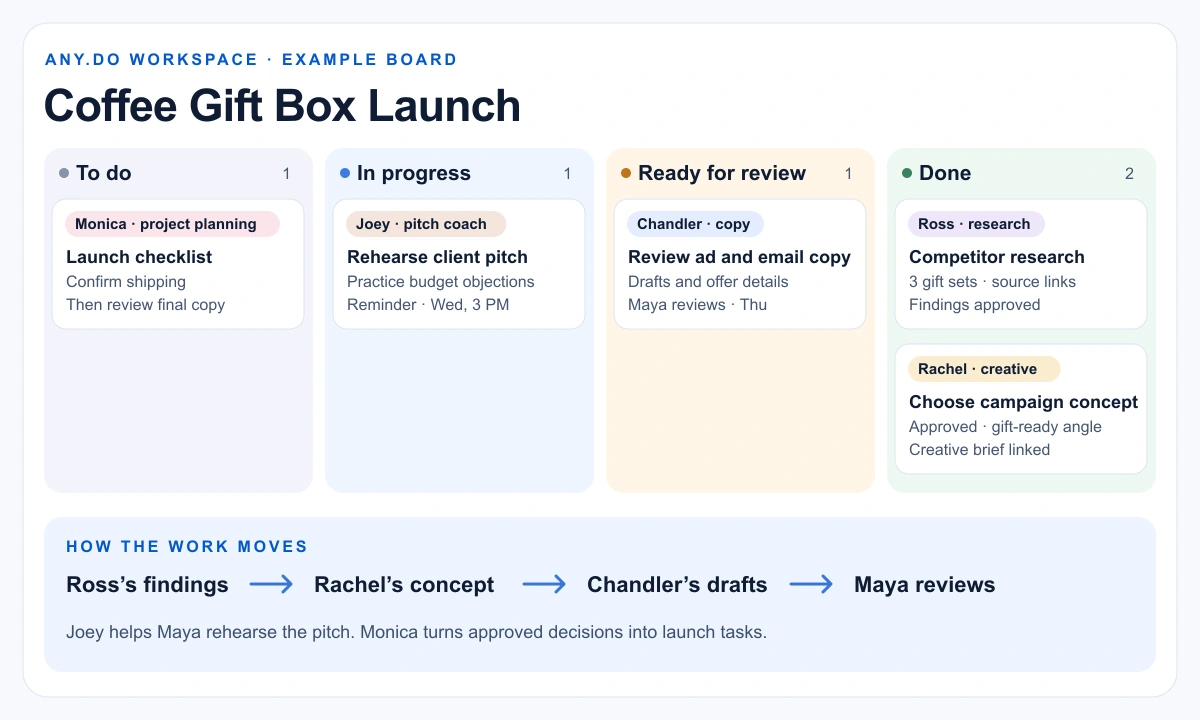 Example board. Ross’s approved research informs Rachel’s concept, which becomes Chandler’s copy brief. Joey helps rehearse the pitch while Monica turns the approved plan into launch tasks. Maya reviews the work and owns the deadlines.
- Give the project its own board. Call it Coffee Gift Box Launch and use simple stages like To do, In progress, Ready for review, and Done. Create tasks for the actual work, such as research, concept, copy, pitch, and launch. You can use the same setup solo or share it with collaborators. Managing board tasks
- Keep the next brief with the work. Put the approved decision and source links in the task notes, attach the brand guide or mockups, and use a checklist for what still needs review. When you start the next agent, point it to the approved task notes if its connection supports that. Use the board as the reference when something changes. Notes, checklists, and files
- Put the real deadlines on the calendar. Give client review and email scheduling a due date, then add a reminder where it would help, like the afternoon before the pitch. Switch to Calendar view to see how the campaign deadlines stack up. If you’re sharing the board, assign approval and publishing to the people handling them. Due dates and reminders · Board views