
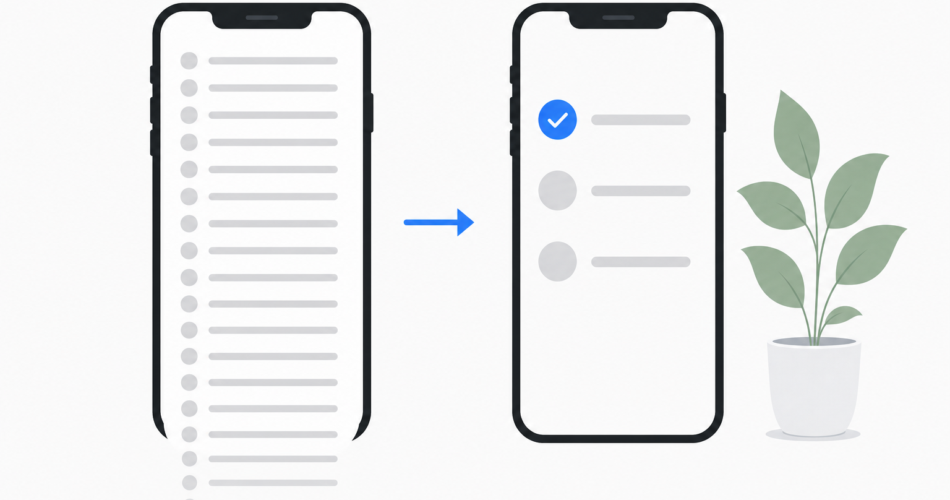
The Science Behind List Overwhelm
You open your to-do list app and feel a familiar wave of dread. There are 47 items staring back at you. Some have been sitting there for weeks. You know you should work through them, but instead of feeling motivated, you close the app and check your email.
This isn’t a willpower problem. It’s a brain problem – and understanding it is the first step to fixing it.
Research in cognitive psychology shows that long to-do lists trigger decision fatigue and activate the brain’s threat response. When your working memory – which can only hold about 4 chunks of information at once – gets overloaded, your brain interprets the situation as a threat. The result: avoidance, procrastination, and a creeping sense that you’re always behind.
Why Your Brain Struggles With Long To-Do Lists
1. Working Memory Has a Hard Limit
George Miller’s famous 1956 research established that the human brain can hold roughly 7 (plus or minus 2) items in short-term memory at once. More recent research by Nelson Cowan narrows this to just 4 chunks. When you scan a to-do list with dozens of items, your brain attempts to evaluate all of them simultaneously – and immediately hits a wall.
The result isn’t just confusion. It’s cognitive paralysis: a state where the brain defaults to inaction because processing the full scope of the list is simply too costly.
2. The Zeigarnik Effect Keeps Unfinished Tasks Alive
In the 1920s, Soviet psychologist Bluma Zeigarnik discovered that people remember uncompleted tasks better than completed ones. Your brain keeps open loops “running in the background,” consuming mental energy even when you’re not actively thinking about them.
A long to-do list isn’t just a list. It’s a collection of open mental tabs – each one quietly draining your focus and energy throughout the day.
3. Too Many Choices Create Decision Fatigue
Barry Schwartz’s research on the “paradox of choice” shows that more options lead to worse decisions and lower satisfaction. Every item on your to-do list is a decision: Do I do this now? Later? Is it urgent? Does it matter? With 50 items, you’re making 50 micro-decisions before you’ve even started working.
Decision fatigue is real and cumulative. By the time you’ve scrolled through your bloated task list, you’ve already used up a meaningful chunk of your daily cognitive budget.
The Hidden Cost of Task List Bloat
A long to-do list doesn’t just slow you down. It actively works against your productivity in ways that compound over time:
- Important tasks get buried. When everything is on the list, nothing stands out. High-priority work competes visually with “buy more paper clips” and you end up doing the easy things first.
- It breeds a false sense of productivity. Adding tasks to a list feels productive. But a list that grows faster than it shrinks is a system that’s working against you.
- It erodes confidence. Looking at unfinished tasks day after day trains your brain to associate your to-do list with failure rather than progress.
What Actually Works: The Short List Approach
The most effective task management systems in use today share one counterintuitive principle: do less, better. Here’s how to apply it.
Rule 1: Your Daily List Should Have a Maximum of 3–5 Tasks
Not 20. Not 10. Three to five tasks – the ones that actually move the needle. Everything else goes into a “someday/maybe” backlog that you review weekly, not daily.
This isn’t about working less. It’s about forcing yourself to identify what’s actually important before the day begins. The constraint is a feature, not a bug.
Rule 2: Separate Capture From Action
Your brain needs a trusted place to dump every thought, idea, and obligation – but that place shouldn’t be your daily task list. Use a two-tier system:
- Capture list (inbox): Everything goes here the moment it enters your head. Unfiltered, unorganized.
- Action list (today): A small, curated selection of what you’ll actually do today, chosen intentionally from the capture list during a brief daily planning session.
Any.do’s Focus Mode and smart list features are built around exactly this principle – helping you surface the right tasks at the right time, without forcing you to manually sort through everything every morning.
Rule 3: Time-Box Your Tasks
A task without a time estimate is an invitation for it to expand indefinitely. Research by Cyril Northcote Parkinson showed that “work expands to fill the time available” – now known as Parkinson’s Law.
When you add a task to your list, attach a rough time estimate. This does two things: it helps you plan a realistic day, and it makes vague tasks feel concrete and doable. “Write report” becomes “Write report intro (30 min)” – a very different cognitive experience.
Rule 4: Do a Weekly List Audit
Once a week, go through your backlog and ask two questions about each item:
- Does this still matter? If not, delete it without guilt.
- Is this actually mine to do? If someone else should handle it, delegate or remove it.
Most productivity experts recommend Friday afternoon or Sunday evening for this review. The goal is to start each week with a clean, intentional list — not a pile of deferred tasks from three months ago.
How to Transition From a Long List to a Smart One
If your current to-do list has more than 20 items, here’s a practical reset:
- Export or review everything. Don’t delete anything yet – just get it all in one place.
- Flag your “must do this week” items – aim for no more than 10–15.
- Move everything else to a “backlog” or “someday” list. Out of sight, but not lost.
- From your weekly list, choose your 3–5 for today. Write them at the top of your daily view.
- Review the backlog weekly, not daily. This keeps it from accumulating unchecked while keeping it out of your daily cognitive load.
Any.do makes this easy with separate lists for different contexts – you can keep a brain-dump inbox, a focused daily list, and project-specific lists, all without them bleeding into each other.
The Bottom Line
Your brain isn’t failing you. It’s doing exactly what brains do when confronted with too many competing demands: shutting down. The solution isn’t more willpower or a better app – it’s a smaller, smarter list.
Start today: look at your current to-do list, pick the three most important items, and ignore everything else until those are done. That single change will do more for your productivity than any new system, tool, or hack.
Want to build a task management system your brain actually works with? Try Any.do free – it’s designed from the ground up to keep your list focused, smart, and short.