If you have ADHD, you have probably downloaded, tried, and abandoned more productivity apps than you can count. The pattern is always the same: you find a new app, spend an hour setting it up, use it enthusiastically for three days, and then forget it exists.
The problem is not that you lack willpower. The problem is that most productivity apps are designed for neurotypical brains. They assume you will check in regularly, follow consistent routines, and feel motivated by tidy lists. For ADHD brains, those assumptions fall apart fast.
The right app works with your brain, not against it. This guide explains what to look for and which apps actually deliver.
Why Standard To-Do Lists Fail People With ADHD
Understanding why regular task management does not work for ADHD is the first step to finding something that does.
Out of sight, out of mind. ADHD affects working memory. If a task is not visible right now, it effectively does not exist. Apps that bury tasks inside folders, projects, or multi-step navigation lose ADHD users immediately.
Decision paralysis. A long list of tasks with no clear starting point is paralyzing. When everything feels equally important (or equally unimportant), the ADHD brain freezes and does nothing.
Inconsistent motivation. ADHD brains are interest-driven, not importance-driven. You might hyperfocus on organizing your inbox for two hours while ignoring a deadline, not because you are irresponsible, but because your dopamine system responds to novelty and urgency, not to rational priorities.
Time blindness. Many people with ADHD struggle to estimate how long tasks take and to feel the passage of time. Without external cues (alarms, reminders, visible countdowns), tasks get started too late or not at all.
What Makes a To-Do List App ADHD-Friendly?
Based on research and the experience of thousands of ADHD users, these are the features that matter most.
Minimal friction to capture tasks. If adding a task takes more than two taps, you will not do it. Voice input is ideal because you can capture a thought the instant it occurs. Typing with autocomplete is the next best thing.
A single daily view. Instead of showing your entire backlog, the app should present only what matters today. This prevents overwhelm and gives you a clear starting point each morning.
Smart reminders that actually remind. Not just a silent notification buried in your lock screen, but reminders that are persistent, customizable, and optionally location-based. “Remind me to pick up groceries when I am near the store” is far more useful than “Remind me at 5 PM” for an ADHD brain that will dismiss and forget a timed notification.
Visual simplicity. ADHD brains are sensitive to visual clutter. Clean design with clear typography and intuitive navigation reduces cognitive load. If an app looks like a spreadsheet, it is not the right app.
Forgiveness for inconsistency. The app should not punish you for missing a day or a week. No guilt-tripping streaks, no red warnings for overdue tasks. The best apps let you pick up where you left off without making you feel like a failure.
Top To-Do List Apps for ADHD in 2026
Any.do
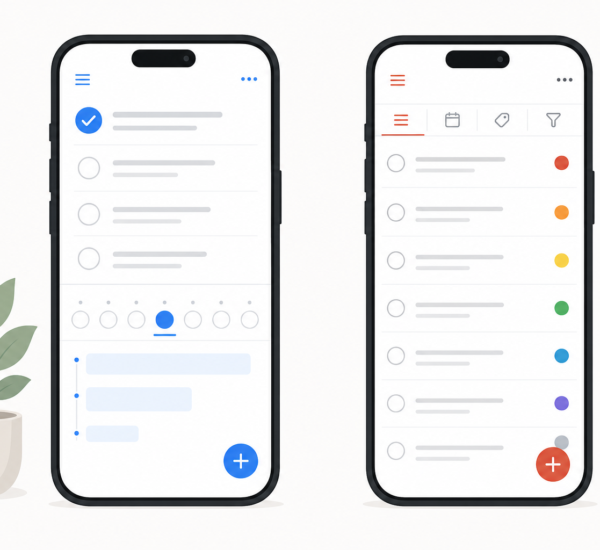
Any.do is one of the best fits for ADHD because it was designed around simplicity from the start. The app’s daily planning screen, called My Day, shows only today’s tasks and calendar events in a single, clean timeline. You see exactly what needs to happen and when, without the noise of your entire backlog.
Key ADHD-friendly features include voice input for capturing tasks instantly, smart reminders that include location-based triggers, a clean and uncluttered interface, natural language input (type “call dentist tomorrow at 3pm” and it parses automatically), and integration with Google Calendar, Outlook, and other calendars so your tasks and events live in one place.
Any.do also supports shared lists, which is helpful if a partner, family member, or coworker helps you stay accountable. For more on building an organizational system that sticks, see the Any.do guide to organizing your life.
The free tier covers basic task management and reminders. The premium plan ($5.99 per month) adds location-based reminders, themes, and unlimited shared lists.
Todoist
Todoist is a strong choice for ADHD users who want more structure. Its natural language input is excellent: type “submit report every Friday at 2pm” and it creates a recurring task automatically. The “Today” view keeps things focused, and the karma points system can provide the dopamine hit that ADHD brains crave.
The downside is that Todoist can become complex as you add projects, labels, and filters. If you are prone to over-engineering your system, you may spend more time organizing tasks than completing them.
TickTick
TickTick combines a to-do list with a built-in Pomodoro timer, habit tracker, and calendar view. For ADHD users who benefit from time-based structure, the Pomodoro feature is a standout. Working in 25-minute sprints with 5-minute breaks provides the external rhythm that ADHD brains need.
The interface is busier than Any.do’s, which may be a drawback for users sensitive to visual clutter.
Amazing Marvin
Amazing Marvin is built specifically for productivity struggles, including ADHD. It offers dozens of customizable “strategies” like task limits (only show 3 tasks at a time), gamification, and micro-tasking (breaking tasks into tiny steps). The flexibility is its greatest strength and its greatest weakness: setup can be overwhelming.
Tiimo
Tiimo is designed specifically for neurodivergent users. It provides visual daily timelines with color-coded blocks and gentle notifications. The app focuses on routines rather than tasks, which works well for ADHD users who need structure around daily habits but struggle with traditional to-do lists.
How to Set Up Your App for ADHD Success
Downloading the app is only the first step. How you set it up determines whether you will still be using it next month.
Keep your system dead simple. Start with a single list. Not five projects, not color-coded categories, not a complex tagging system. One list: “Today.” Add tasks each morning. Check them off. That is it. You can add complexity later, but only if you genuinely need it.
Use voice input. The moment a task pops into your head, say it out loud. Any.do’s voice input captures it instantly. This is critical for ADHD because the gap between thinking of something and forgetting it can be seconds.
Set reminders for everything. Not just meetings and deadlines. Set reminders for starting tasks, taking breaks, eating lunch, and going to bed. Your phone becomes your external memory system. Any.do’s reminder features support time-based, recurring, and location-based triggers, covering every scenario.
Do a 2-minute daily planning ritual. Each morning, open your app and review what is on your plate. Move the three most important tasks to today. That is your plan. It takes two minutes, and it gives your day a starting point instead of a blank canvas.
Celebrate completions. Check off a task and take a moment to feel good about it. This is not silly; it is neuroscience. The dopamine hit from completing a visible task reinforces the behavior and makes you more likely to do it again.
When Apps Are Not Enough
A to-do list app is a tool, not a cure. If you are struggling with ADHD significantly, consider these additions:
Body doubling. Work alongside someone else, in person or virtually. The presence of another person provides accountability and reduces the activation energy needed to start.
Accountability partner. Share your daily task list with a trusted person who checks in at the end of the day. Any.do’s shared lists make this easy.
Professional support. A therapist specializing in ADHD or an ADHD coach can help you build strategies tailored to your specific patterns.
For more on building focus habits that complement your app, read the Any.do deep work guide.
Conclusion
The best to-do list app for ADHD is the one you actually use. That means it needs to be simple enough to open daily, smart enough to remind you without you asking, and forgiving enough to welcome you back after a week away.
Any.do hits that balance for most ADHD users. Its My Day view shows only what matters now, its voice input captures thoughts before they vanish, and its reminders fill in where working memory falls short.
Start with one list and one day. Build from there. Your brain works differently, and that is not a flaw. You just need tools that understand the difference.